The third time is the charm with the current-generation Toyota Tundra
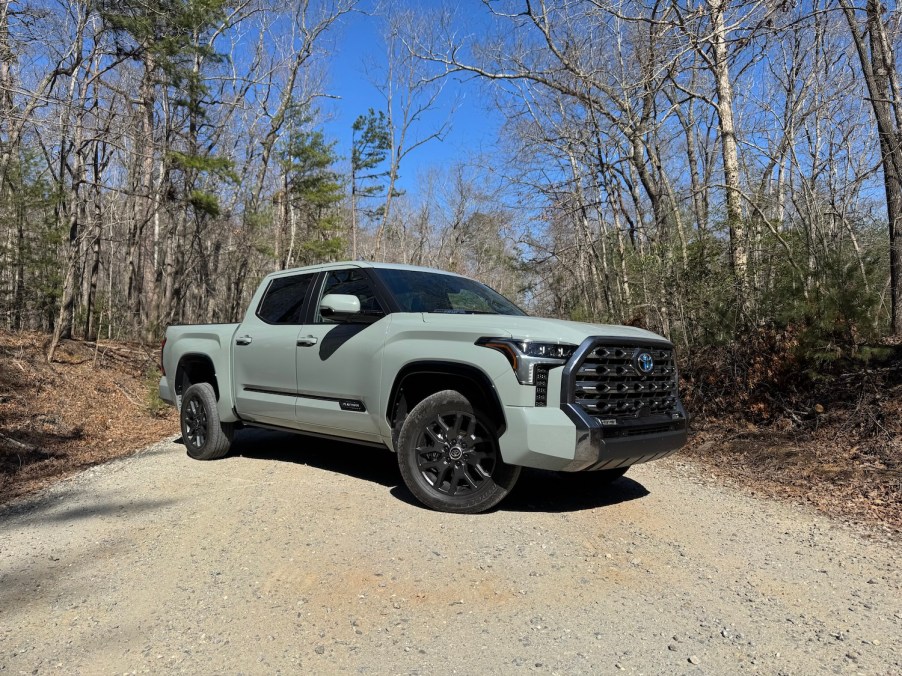
I’m far from being considered a princess, but I’ve had a Goldie Locks story with the current-generation Toyota Tundra. I’ve had a few different models since it launched in 2022 and the 2024 Toyota Tundra Platinum was the truck that was just right.
The third time is the charm for the current-generation Toyota Tundra
I finally enjoyed one current-generation Toyota Tundra model as much as I liked the 2021 Toyota Tundra 1794 Edition in 2021. That V8 engine was hard to beat despite only getting 13 mpg.
I’ve been doing this job for a while because I like to drive all the things. In 2022, I had a Tundra 1794 Edition with an 8.1-foot bed. That was extremely long, making it difficult to maneuver in tight areas.
Plus, I had the standard 3.4-liter V6 engine with 389 hp and 479 lb-ft of torque. This engine is a stout start, but it wasn’t as smooth or fun as the outgoing V8 engine.
Then I had a 2023 TRD Pro model. I was extremely excited to hit the dirt hard with it. But the engine noise is piped into the cabin,making it loud at all times.
The ride was stiffer and the seats were firm. It wasn’t as comfortable as the two models I had before it. Plus, the lack of tow hooks and the low-hanging tailpipe felt limiting in the woods.
However, the TRD Pro had the irresistible i-FORCE Max Hybrid powertrain. The 3.4-liter V6 engine is paired with an electric motor to crank out 437 hp and 583 lb-ft of torque. It can help the Tundra accelerate from 0 to 60 mph in 5.7 seconds.
My week with the 2024 Toyota Tundra Platinum has been the best so far.
But before I dive into what I liked, here are a few potential drawbacks:
- The Tundra is pretty large and wide. Thank goodness for the 360-degree camera view.
- I got 17.6 mpg while the Ford F-150 Hybrid provides 25 mpg.
- The battery takes up space under the seats in the second row.
- Some interior materials like silver-painted plastics may feel cheap.
So far, this Tundra model has been the most comfortable to operate. It’s extremely smooth on the pavement and in the woods as it absorbs larger impacts and pot holes with ease.
The interior is peaceful and quiet aside from occasional, deep engine roars. It’s much quieter than the TRD Pro. Plus, the large seats provide plush, supportive padding.
There have been tech upgrades to note. For example, the truck automatically provides parking camera views when you slow down. In the GMC Sierra, I start to park but then get delayed while trying to find the camera button in the touchscreen menus.


Also, the wireless phone charging pad has been moved to a more convenient location. Your phone will no longer slide out of position. Connecting to wireless Apple CarPlay and fast and easy.
The 14-inch touchscreen is vibrant and easy to use. The Toyota Tundra has plenty of physical buttons and controls that can be used while wearing work gloves as well.
Thanks to not having a massive bed length, the CrewMax model is easy to park. But turning around in tight spots takes a few extra steps.
Also, the tailgate step is beneficial for bed access. However, rivals with built-in corner steps seem a bit smarter. You don’t have to wait for a power-step to fold out and that component does seem easy to damage.
This model also had my favorite interior thanks to the massive panoramic sunroof. The black and white upholstery is attractive and blends well with pops of wood appliques. I wasn’t too thrilled with all the red leather involved with the TRD Pro model.
Every Tundra I’ve driven has excelled with storage space. There are cup holders, bins, trays, and cubbies everywhere you look. Passenger space is great as well with plenty of room for taller adults in the front and rear.
Overall, the Toyota Tundra is a well-rounded truck. It’s comfortable and capable with a user-friendly design. While it could be better on gas and tows less than rivals, it checks off a lot of boxes. I’m living proof that you can find the model that’s just right.